Crypto rewards site software, with payouts sent from your own wallets.
Run a crypto rewards site on your own domain. Members earn points from offerwalls and surveys, then redeem them for coins such as Litecoin, or for gift cards and subscriptions. Every redemption lands in your queue, and you send it from your own wallet or gift card supplier. RewardsLabel runs the site and never touches the funds.
- Licence
- $149 a month, no revenue share
- Payouts
- Sent by you, from your accounts
- Catalogue
- Crypto, gift cards, PayPal, subscriptions
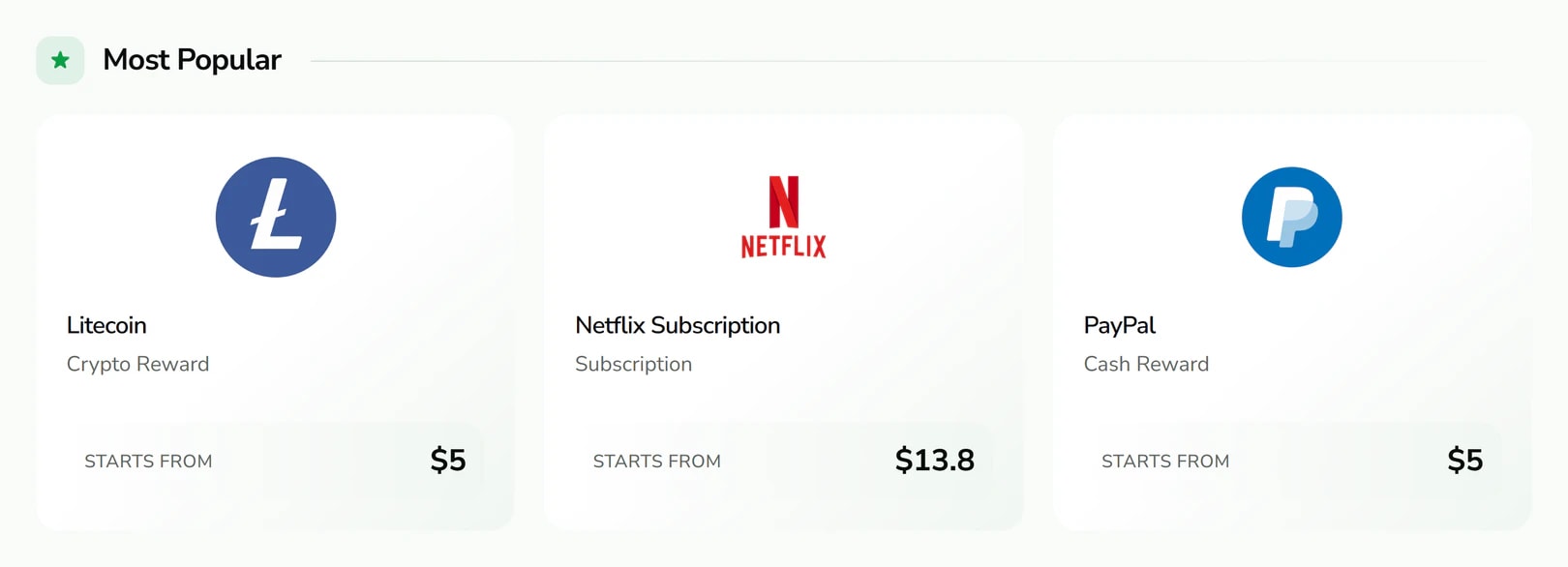
Build a catalogue of crypto and gift cards.
On a crypto rewards site, members judge the whole operation by its cash-out page. You decide every option on it, and you can change them as fees and demand move.
One entry per coin or card
Add Litecoin, another coin or a gift card brand as its own reward, with an image, a category and a description.
Minimums you can afford
Set the amount options for each reward. A $5 Litecoin payout and a $13.80 subscription can sit side by side in the same store.
The field members fill in
Name what the member must enter, such as an LTC wallet address or a delivery email. It appears on the redeem form and next to the request in your queue.
Hide a reward without deleting it
Switch a reward off when a network gets expensive or a card brand runs short. It leaves the store and comes back when you switch it on.
How a crypto payout moves from request to wallet.
RewardsLabel records the request. You hold the wallet and decide when, or whether, to send.
- 01
The member redeems
They pick a coin or card, choose an amount and enter their address. The points leave their balance and a pending request opens.
- 02
You review the request
It shows the member, reward, amount and address. Check the member’s activity and IP history before you act.
- 03
You send the payment
Pay from your exchange account, your wallet or your gift card supplier, using the address the member entered.
- 04
You close the request
Mark it completed once the transfer confirms. To decline it, reject it, which closes the request without returning the points, or refund it, which returns the points to the member’s balance.
Know what each payout costs before you list it.
Fees decide which rewards you can offer at low minimums. These are the figures published when we checked on 24 October 2026. Confirm them before you set your prices.
Crypto from an exchange
- What the provider publishes
- A third-party comparison updated in October 2026 listed USDT withdrawals on the TRON network at 0.5 to 1.99 USDT, with 1.5 USDT on Binance, OKX and Bitget
- Worth knowing
- Fees change with network load and differ by coin and exchange. Read the comparison
PayPal Payouts
- What the provider publishes
- 2% of each US payout, capped at USD 1.00, on PayPal’s US fee page
- Worth knowing
- Needs a PayPal business account approved for Payouts. PayPal business fees
Gift cards through Tremendous
- What the provider publishes
- Gift cards and prepaid cards are free to send; PayPal, Venmo and other cash options cost 4 to 6%
- Worth knowing
- Tremendous pricing
Gift cards through Tango
- What the provider publishes
- No minimums and no sign-up fees; the pricing page lists no fee schedule
- Worth knowing
- Ask Tango for its funding fees before you rely on it. Tango pricing
| Payout route | What the provider publishes | Worth knowing |
|---|---|---|
| Crypto from an exchange | A third-party comparison updated in October 2026 listed USDT withdrawals on the TRON network at 0.5 to 1.99 USDT, with 1.5 USDT on Binance, OKX and Bitget | Fees change with network load and differ by coin and exchange. Read the comparison |
| PayPal Payouts | 2% of each US payout, capped at USD 1.00, on PayPal’s US fee page | Needs a PayPal business account approved for Payouts. PayPal business fees |
| Gift cards through Tremendous | Gift cards and prepaid cards are free to send; PayPal, Venmo and other cash options cost 4 to 6% | Tremendous pricing |
| Gift cards through Tango | No minimums and no sign-up fees; the pricing page lists no fee schedule | Ask Tango for its funding fees before you rely on it. Tango pricing |
At the 1.5 USDT that comparison lists for Binance, a withdrawal costs about 30% of a $5 payout and 6% of a $25 one. Set crypto minimums with that arithmetic in mind, or list coins whose networks cost less to use. Minimums are set per reward, so you can adjust them when fees move.
Crypto payouts cannot be pulled back.
A card payment can be disputed. A sent coin cannot. Build your checks around that.
Wait before you pay out fresh earnings
Offerwall partners can reverse a conversion after it has posted. Every redemption waits in your queue until you act, so you can leave a request built on fresh earnings pending until a reversal has had time to arrive. If a chargeback lands first, refund the request: the chargeback has already taken the reversed points, and rejecting would take them a second time.
Chargebacks deduct points automatically
When a partner sends a chargeback postback, the points come off the member’s balance and the deduction is recorded.
Read the history before you send
Every member has an activity log and an IP history. Accounts sharing an IP, or a sudden jump in earnings, deserve a closer look before an irreversible transfer.
Suspend or freeze while you check
Set an account to suspended, frozen or banned while you investigate. Its pending requests stay in your queue until you decide.
Common fraud on rewards sites involves VPNs, proxies, multiple accounts and emulators. RewardsLabel does not block these automatically, so a manual review before each payout is part of running a crypto rewards site. The guide on how to start a GPT site covers the checks worth setting up from the first day.
What you need before the first payout.
Setting up the site takes a few steps. The payout side needs accounts that only you can open.
On the platform
- The member site on your domain, with its cash-out page
- The reward catalogue, its amount options and entry fields
- The redemption queue, with every status and address
- Points taken on redeem, and refunds back to the balance
- Chargeback handling from partner postbacks
In your name
- An exchange account or wallet for each coin you list
- Accounts with gift card suppliers, if you list cards
- Offerwall and survey partner accounts that fund the payouts
- Terms that state your minimums and review times
- Any identity checks or tax reporting your location requires
If you pay members in the United States, note that the IRS reporting threshold for prizes and awards on Form 1099-MISC rose to $2,000 for tax years beginning after 2025, according to the IRS instructions. Whether it applies to your members depends on how your site is set up, so ask a tax professional.
Questions about paying members in crypto.
Custody, coins, fees and what happens when an offer is reversed.
- Can I run a crypto GPT site on RewardsLabel?
- Yes. List coins such as Litecoin as rewards next to gift cards and PayPal, set their amounts and the address field, and members redeem points for them. You send each payout from your own wallet or exchange account, then mark the request completed in your queue.
- Does RewardsLabel send crypto to my members?
- No. The platform records requests and tracks their status, but it holds no wallets and connects to no exchange. You send every payout yourself, which also means you choose the timing and can stop any payout you are not comfortable with.
- Which coins can I offer?
- Any coin you are able to send. Each reward is an entry you create with its own name, image, amounts and address field, so adding a coin does not depend on an integration. Pick coins whose network fees suit the minimums you want to offer.
- Can members cash out to gift cards instead?
- Yes. Gift cards and subscriptions are rewards like any other. You buy and deliver them through a supplier account you hold, then mark the request completed. Members see the cards in the same rewards store as the coins, so they choose what suits them.
- What if a partner reverses an offer after I paid in crypto?
- The chargeback postback deducts the points, which can leave the member’s balance below zero, but coins already sent stay sent. That loss is yours. Reviewing each request before you send it matters most when the payout is crypto.
- Does RewardsLabel take a cut of my payouts?
- No. The licence is $149 a month or $1,490 a year, plus $25 activation, with no revenue share. Network and supplier fees are between you and those providers, and they are the same whichever software runs your site. See pricing for the details.
Keep reading
- Payouts and redemptionsList the rewards members can redeem and approve, reject or refund every request from one queue.
- Get-paid-to (GPT) sitesHosted get-paid-to site software with offerwalls, surveys, payouts and referrals on your own domain.
- How GPT sites make moneyThe operator’s side of the get-paid-to business model: offer margin, member share, payout fees, reversals, cash flow and a sample monthly P&L.
- How to start a GPT siteThe operator’s order of work for a get-paid-to site: audience, software, legal pages, partners, points, payouts and fraud.
- Community rewards sitesA branded rewards site for creators, publishers and Discord or gaming communities, with referrals and chat built in.
- Pricing$149 a month or $1,490 a year, plus a $25 activation fee. No revenue share.
Run a crypto rewards site from your own wallets.
Set up the site and the domain first. Add coins and gift cards to the catalogue once your payout accounts are ready.